



|
Rudolf and Larissa Jung
|
|
To contact us: |
|
Phone in Germany: 0160 4637 132 Phone from US: 011-49-160 4637 132 E-mail: flodur54@hotmail.com |

|
Kayaking: Because of the lack of currents and the low wave action, sea kayaking is an easy and safe activity in the area between beach and reef. Life vest of several sizes are available. You can make interesting tours up and down the coast using our three sea kayaks. If you are in good physical condition it is possible to cover by kayak considerable distances. Most of our guests use the kayak for getting to the reef for snorkeling. If you take the kayak to the reef, please anchor it in a safe distance from any coral formations. Please never make an attempt to cross the reef! Even in calm weather a wave could turn over your kayak and in the middle of the reef this can be extremely dangerous. In case Kayaks are left unattended in the beach area, they should be always chained and locked to a palm tree. Never leave any accessories (vests, paddles, snorkeling gear) unattended in the beach area. Paddles are very expensive (>100 USD) and difficult to replace. It is possible to take our kayaks for off-site ours (e.g. exploring lagoons or to bird islands in Chetumal Bay), but please first obtain our permission and discuss proper means of transportation. |
|
Snorkeling Snorkeling is certainly one of the most fascinating activities to engage in while vacationing at the Costa Maya. The Mesoamerican Barrier Reef in front of the Costa Maya is the second largest barrier reef in the world. In the Mahahual area it has many wonderful snorkeling sites and virtually all of them can be easily reached right from the beach, i.e. don’t require booking a tour with a tour operator. If you are not a good swimmer you can take our kayaks to get to the reef. |
|
While relaxing at Casa del Cielo de las Estrellas you can enjoy activities like swimming, snorkeling, kayaking or fishing that come naturally with living on a beach with the world’s second largest barrier reef in swimming distance. The Costa Maya is paradise if you are a collector of Sea-Beans. Mahahual offers additional activities. Most notably, there are several dive operators that offer the exploration of our spectacular reefs. If you arrive by car you may consider sightseeing excursions to Mayan archeological sites and to other interesting places in Quintana Roo. |





|
Swimming The drop off in our area is very good, i.e. swimming is possible (and enjoyable) right from the beach. Immediately at the shore the ground is sandy, not muggy like in some Costa Maya areas, and the water depth drops quickly to 4-6 feet. After about 50 feet a turtle grass flat begins and for a few feet the water depth is only about 2 feet (no problem getting through there swimming however). About 100 feet from the beach the water depth reaches 7-10 feet (and remains at this depth the whole distance to the reef). Swimming safety Swimming is very safe; even for a beginner. Because of the barrier reef, we virtually don’t have any wave action at the shore and no currents. Wear beach shoes (or diving boots, surf boots or similar) whenever you enter the water. Even though our beach is a sand beach, there can be sharp mussel shells or other creatures buried in the sand. While living at the beach, nothing seems worse than having a cut wound that prevents one from enjoying the water. So -especially for children- we recommend always wearing beach shoes for swimming and even for walking on the beach. If you like to swim or surf in high waves, a small portion of the coast 15 km south of Mahahual is not protected by the reef. Large ocean waves roll unimpeded onto the shore. However, you have to be a good swimmer to test these waters. On some days you can encounter strong seaward rip currents. The sand beaches in this area are incredibly wide and it is therefore also a very good spot for beach combing (shells, sea-beans, etc.). This beach is easily accessible. From Casa del Cielo de las Estrellas drive 6 km south on the beach road. |
|
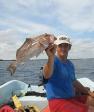
Fishing Mahahual is a potential paradise for sport fishing enthusiasts. It offers top fly fishing opportunities (Chetumal Bay flats), excellent deep sea fishing conditions- perhaps the best anywhere on the Caribbean coast of Mexico - and, less known, spectacular bottom fishing at the reef drop offs in 100-200m depths. In addition, seasonally, shore fishing can yield impressive results. The full use of this potential is currently still limited by the scarcity of guides, providers and operations that offer services to visitors. However, these services are developing and we will list information and links here as we become aware of them. For fishing pictures– click here.
Fly Fishing Chetumal Bay has thousands of acres of mangrove lined flats which produce enormous numbers of tarpon, bonefish, permit, snook, and snappers. Though (still) less known for fly fishing than Bahia Esperito Santi Bay (south of Tulum), fisherman that have fished both waters give Chetumal Bay an even higher rating then fishing the renowned Esperito Santi Bay flats. Chetumal Bay is easily accessible from Xcalak (about 30 minutes by car from Casa del Cielo de las Estrellas). It is best to make arrangements with Xcalak fishing guides that are specialized in fly fishing ( http://www.xcalak-flyfishing.com/ http://www.josexcalaktours.com/ ). We have never tried Chetumal Bay fly fishing ourselves, but several of our guests did: They all were ecstatic in describing their experiences.
Deep Sea Fishing and Bottom Fishing Witness to the excellent deep sea fishing conditions in the Costa Maya region are big fishing tournaments conducted every year in June-July in Mahahual. Sailfish, blue marlin, white marlin, dorado (dolphin), kingfish and barracudas are regularly caught in often impressive sizes. Bottom fishing at the reef drop off in 100-200 m depths yields a seemingly unlimited number of black and red snappers as well as occasionally large groupers. More often than not, the limiting factor for the catch is not the abundance of fish but the ability to reel hooked fish up to the surface in quick succession! After a few catches, reeling again and again 100s of meters of line becomes to feel like heavy lifting. Currently the few commercial operators that offer deep sea or bottom fishing cater mostly to the cruise ship tourists and tours are quite expensive ( http://www.costa-maya-tours.com/Fishing.cfm ). Much more affordable arrangements with independent local boat captains or fisherman are possible, but may not be always available. Huacho, one of our neighbors at km 9, has worked previously as a dive master and knows the Mahahual reefs very well. He speaks English and offers snorkeling and fishing tours. Another of our neighbors, Jorge Loria (jcloriau@hotmail.com) at km 9.5, is also a retired dive master. He offers 4-hour fishing/snorkeling tours with his boat for 165 USD. He also speaks very well English. In addition you can try to inquire at the fisherman dock or in the village. Most local options don't provide high-end equipment or boats, so you might consider bringing your own gear.
Shore Fishing Shore fishing can be done virtually from everywhere at the Costa Maya. A very good spot is at the bridge of Rio Bermecho (km 4 south of Mahahual, click here for map). During the rainy season (May-December) Rio Bermecho carries a lot of water from the mangroves and large schools of small fish aggregate at its outflow to the sea, attracting numerous large predatory fish. An even better place for shore fishing (snooks, permits, large snappers) is at Rio Huach, an outflow from Laguna Huach. You have to drive approx. 15 miles (30 min) along the beach road in direction of Xcalak. Ask our caretaker for advice. Shore fishing from Casa del Cielo de las Estrellas beach is usually not spectacular, but seasonally can be very good. With some patience ½-1 lb size mutton snappers, yellow fin snappers, large striped grunts and schoolmaster snappers are a sure catch year-round. Best time for shore fishing is 1 hour before and several hours after nightfall. Best bait is sardines (caught with cast net). Our children (with a lot of patience) directly from our beach catch regularly quite large permits, occasionally barracudas and once caught a huge 20 lb Crevalle Jack. |


|
Diving The Costa Maya offers magnificent scuba diving conditions. The Meso-American Barrier Reef, second only to the Great Barrier Reef in Australia, is fringing its coast. In addition, Banco Chinchorro, the largest atoll of the Northern Hemisphere, is located in only 20 miles off the beaches of Mahahual. Many divers consider the Mahahual-Xcalak section of the Mesoamerican Barrier Reef as the most beautiful, the most diverse and the least disturbed stretch of this 900 km -long reef system, far surpassing Cozumel or well-known dive destinations in Belize. The Mahahual area has two parallel lines of reef barriers. The first (shallow) reef barrier is only 50-300 m off the coast. It can be seen from almost everywhere from the Costa Maya shore because it reaches the water surface. The second (outer) line of the reef barrier is located about 300-600 m off shore and begins at about 10 m below the surface. Its finger formations create spectacular canyons and swim-through’s. The reefs are still very healthy with almost 100 coral species, huge barrel sponges and almost 200 species of fish. Scuba diving in the area has been infrequent up to now with little impact on the reefs. Most dive sites have only recently been charted and many sites remain to be explored. The hope is that reef health can be maintained despite growing tourism by strictly enforcing environmentally sound diving practices.
Aside from the magnificent reef system, a second, but equally important aspect differentiates the Costa Maya from other diving destinations: Dive operators here do not use “cattle boat” approaches like in Florida or at other Caribbean dive resorts. Dive groups are small and personable and experienced dive masters always accompany groups under water.
The highlight for many of Casa del Cielo de las Estrellas guests has been the opportunity to enroll in scuba diving courses with Mahahual dive operations which are offered for a wide range of certifications, from open water to instructor level.
For a memorable scuba diving experience with a small dive operation that provides close attention to your special needs we recommend Nomad Divers (http://www.Nomaddivers.com). Selma, the dive instructor, operates from the Travel In’ restaurant in only 3 km distance from Casa del Cielo de las Estrellas. She can pick you up from our house.
Kabah-Na, a small cabana resort in walking distance (300 m south) from Casa del Cielo de las Estrellas, operates a newly opened dive shop. They received very good reviews and were highly recommended by some of our recent guests. Lois, the dive master, also offers other activities (kayaking Laguna Huach, Chetumal Bay and Laguna Bacalar).
Some of our previous guests liked diving with the Dreamtime Dive Resort ( http://www.dreamtimediving.com ) in Mahahual. Dreamtime specializes on diving of the Meso-American Barrier Reef in the Mahahual area and is certified to offer Chinchorro diving. However, on cruise ship days Dreamtime may have booked their boots to full capacity, as they are the exclusive provider for the cruise lines.
Divers that like additional diversity may also consider diving in the protected reefs of the southern Costa Maya in the Xcalak Reef National Park. By car Xcalak can be reached from Casa del Cielo de las Estrellas in about 30 minutes. A reputable dive operator in Xcalak is the XTC dive center ( http://www.xtcdivecenter.com ). XTC is the only operator that offers boat rides to San Pedro, Ambegris Caye, Belize. This is a one day tour. In San Pedro you need to book a local operator for diving one of the well-known Ambegris Caye sites (Hol Chan marine reserve, etc.).
|
|
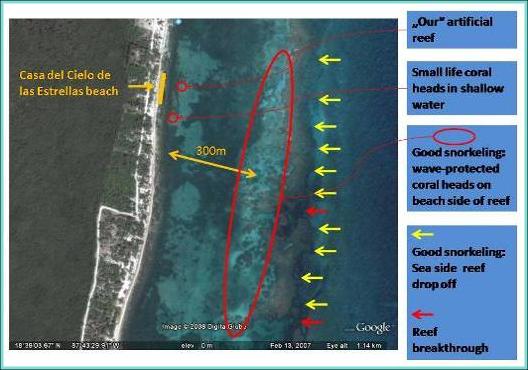
Where and when to snorkel The immediate area in front of Casa del Cielo de las Estrellas offers arguably the most beautiful snorkeling sites along the whole Mahahual coast. On the wave-protected side of the barrier reef (2-300 m out) large coral heads and coral aggregations form a very pretty underwater park (see snorkeling pictures under Gallery). About 300 m south-east from our beach a channel through the barrier reef allows safe passage and exploring the other side of the reef (about 20 feet drop off with some phantastic coral formations). The variety and abundance of reef fish and creatures is very good, but at each specific site this can change depending on the time of the day. The best time for snorkeling is between 10 am and 3 pm, which also offers the best light conditions. We built “our” own artificial reef just 30 m from the beach that is teaming of beautiful fish and reef creatures. Also some very nice small life coral heads can be explored very close to our beach (see map). The library in our house contains several identification guides for reef fish and reef creatures. Identifying and discussing encountered fish with friends and family can be a great pastime after a long day of snorkeling. Normally, especially during the calmer Summer months, the water is crystal clear. On stormy days visibility is impacted in the proximity of the beach, but usually remains good at the wave-protected large coral formations on the beach side of the reef (see map). If you are an enthusiastic (and adventurous) snorkeler, bring underwater lamps and try a night snorkeling trip. After dark, very close to the beach, you will encounter astonishing numbers of fish and reef creatures that you virtually never see during the day (moray eels, flying gurnard, octopuses, squids, snails and conches, hermit crabs, sea cucumbers, sea urchins, etc.). Day-active fish, even very big specimens, don't flee and can be approached very closely. Snorkeling safety tips To access snorkeling sites on the sea-side drop off of the reef, for safe passage of the barrier reef, swim along the channels indicated in the map. Don’t use the kayaks to pass the reef at these channels, because you may not see underwater obstacles or misjudge the water depth. NEVER try to pass the reef in other areas or to walk over exposed parts of the reef! Aside from the damage you may cause to living corals, a breaking wave could smash you with high force into the coral rock formations. This can happen on a seemingly calm day. The consequences could be dangerous, even fatal. Snorkeling will expose your skin to sun radiation. The water filters only a small percentage of the UV light and, if unprotected, trips as short as 30 minutes can result in very severe sun burns. A simple remedy is wearing a T-shirt and to apply to exposed skin an oil-free, waterproof sun blocker with a protection factor of at least 40 SPF. Virtually all life corals (rock corals, fan corals, soft corals) have the ability to cause skin irritations or rashes if your skin comes in contact with them. The general rule therefore is to never touch anything and to keep a safe distance to coral formations. Species of stinging jellyfish are uncommon in our area and we never had (or have heard about) an unpleasant encounter. After a storm you may find a Portuguese Man-Of-War washed ashore. This is a very pretty but toxic jellyfish easily recognized by its gas-filled float. Don’t touch it! Even dead, they can sting! During favorable weather conditions in springtime (March-April) a small brownish jelly fish, the Sea Thimble, can appear in swarms. While itself fairly innocuous, the larvae of this jelly fish are mildly toxic and seem to accompany swarms of adults. They are called by the locals “Pica-Pica” for a reason: they can cause rashes to sensitive skin. Therefore, if possible, we recommend to avoid snorkeling during (rare) blooms of this tiny jelly fish. Any swarming period lasts only a day or two and you may have sufficient chances on other days to fill your “quota” of enjoyable snorkeling trips during your stay. Don’t be concerned about sharks. Dangerous shark species do not inhabit the area between beach and reef. Overfishing has resulted in a sharp decline of shark populations everywhere in the Caribbean. They are very rare even in open water outside of the reef. In 15 years I have seen sharks only twice while snorkeling (sea side of reef). If you come upon a shark in the reef it will be almost certainly the harmless Nurse Shark. You will occasionally encounter several other large fish species while snorkeling: Eagle Rays, Parrot Fish, Tarpoons and Barracudas. They are all harmless. Murray Eels, Electric Rays and Sting Rays can be approached very closely: Never try to touch them as they can inflict painful bites, electric shocks or stings! Recently, there have been many sightings of Lion fish, an invasive species from the South Pacific that unfortunately has been spreading into the Costa Maya reefs. While very beautiful, it has venomous spines in its fins. It is not aggressive– Still keep a save distance! |
|
Snorkeling gear Some free to use snorkeling gear (masks, snorkels, fins) is in the house. If you are an avid snorkeler we recommend bringing your own quality equipment. A fitting mask is important if you don’t want to constantly clear your mask while snorkeling. Protection while snorkeling Corals and other water creatures like jelly fish can cause skin irritations if you come in contact with them. Consider bringing a thin Lycra dive skin for protection. Otherwise wear a T-shirt (also as protection against sunburns). |

|
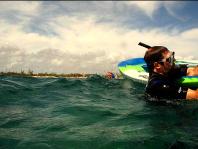
At the reef for snorkeling with the kayak. You can see Casa del Cielo de las Estrellas in the far on the beach. If you are an average swimmer, you don't need the kayak to get here. |
|
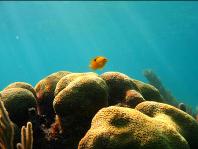
A juvenile Rockbeauty Angelfish levitating over a brain coral. As the name indicates, this is one of the prettiest coral fishes of the Caribbean Reefs. |
|
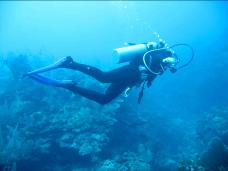
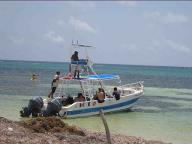
Mahahual dive operators offer well maintained equipment and state of the art boats. Dive groups are small and dive masters always accompany groups underwater. |
|
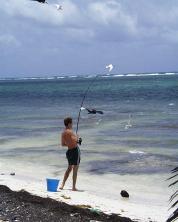
Shore fishing at Casa del Cielo de las Estrellas. Sea birds hope to get a share of the sardines that are used for bait. |
|
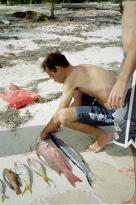
Afternoon catch |
|
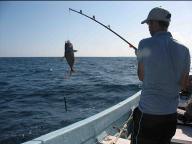
Bottom fishing |



|
Beach combing for Sea Beans and other Drift Good Treasures Beach combing for sea-beans, sea shells and other drift good is a potentially fascinating activity at Costa Maya beaches. For Sea-Bean and drift good treasure pictures-click here If you are already an experienced beach-comber, especially if you are into sea-bean hunting, your first stroll along a Costa Maya beach will convince you: This is sea-bean collector’s paradise! The Costa Maya receives year-round a constant stream of drift goods carried here by the Caribbean Current. This large ocean current enters the Caribbean Sea at the southernmost islands of the West Indies and passes our beaches on its way north toward the Golf of Mexico. Judged by labels on plastic drift good (that unfortunately also arrives) the origin of most drift goods is Central and South America (as far as Brazil) and the Caribbean islands. The so called wrack (drift deposits accumulated at the high water line) is full with seeds and nobody else seems to collect them. Sea-bean hunting has only recently become a new hobby to us. In previous years we noticed occasionally among drift goods on the beach a so called Sea Heart (very large, up to 3 inch-wide, beautifully heart-shaped brown seed; locally called Corazon de Mono- Monkey Heart) or a Hamburger Bean (a name, which is aptly descriptive; the locals call them Ojo de Venado- Deer Eye). We wondered from which trees they came from, but our guides on Q. Roo flora did not show any of these seed and we never got curious enough to research this issue any further. However, a friend from Mahahual asked us to get for her a field guide on drift seed (Sea Beans of the Tropics, A Collector’s Guide to Sea-Beans and other Tropical Drift on Atlantic Shores; by authors Ed Perry and John Dennis) and to bring it along at our next visit. We liked the book so much that we got one for us too and our first –now guided- trips to beaches south of Mahahual netted us hundreds of beautiful hard-coated sea-beans. Sea-Hearts, Red and Brown Hamburger Beans are the most abundant sea-beans. The brightly colored Saddle-Beans are also very common. In addition we found many of the rarer sea-bean species, such as the legendary Mary’s Beans, “Little Marbles” (Oxyrhynchus), Brown and Yellow Nicker-Beans, Katie’s Beans, and Red Horse-eye Beans. The natural history of drift seed is quite interesting. Many of these drift seed are from woody Lianas (aka monkey vines), mostly belonging to the legume family, originating in the rain forests of the Amazonas and Orinoco basins and reaching the Atlantic Ocean by river. They often float for years riding the ocean currents until they get washed up onto often distant shores - as far as Ireland and even Scandinavia. Even after these long voyages they look startling beautiful and most of the hard-coated sea-beans are viable after many years in the sea. We started a germination experiment and -amazingly- got most species to germinate. The trick is to drill holes through the hard seed coat. We planted them in the back garden of our property at larger trees. They hopefully will grow well and can tolerate the salt in the air. In case you come to visit us at Casa del Cielo de la Estrellas you might be able to inspect our own monkey vines that bear fruits. The Sea Heart pod is the longest plant fruit known- they are 1-2 m long! The Mary’s bean vine is a morning glory with beautiful large yellow flowers. We do have already a Nicker-Nut vine growing. It sprung up after Hurricane Dean and is covering one of our Sea Grapes (Uva del Mar) with an impenetrable thicket of thorny vines. Much harder than finding sea-beans is collecting marine shells. Best spots for this activity are rocky shore lines and there are only few such places along the Costa Maya coast. Queen conch populations- once inhabiting the sea grass flats of our coast by the millions have dramatically plummeted in recent years and so have declined the number of shells of this species that you could find on the beaches. However the shells of many smaller gastropods like cowries and West-Indian Top Shells can be collected abundantly at Punta Herradura, which is located about 15 km south of our property. |

|
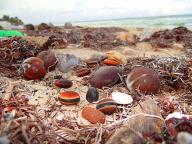
The so called wrack line of Costa Maya beaches is full with Sea-Beans and other drift good treasures. |
|
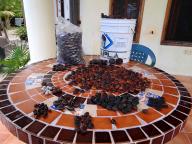
Sea Bean Harvest: We found more than 1000 hard-coated drift seed while conducting 8 collection trips to beaches south of Mahahual. |